

November 2026
New research exposes how subtle interpersonal discrimination affects obese men in retail settings, as both job seekers and customers, with direct implications for workforce inclusion and business performance.
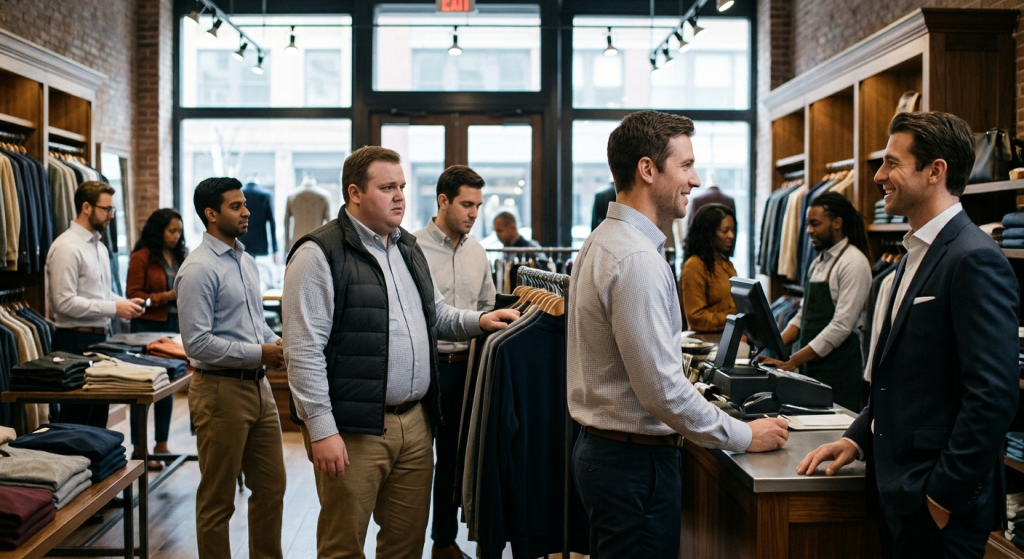
Weight bias is frequently framed as an issue that disproportionately affects women. A growing body of research is challenging that assumption. A study by Professor Mikki Hebl of Rice Business, alongside colleagues from the University of Houston and the University of Washington, examined how obese men are treated in retail environments, both as job applicants and as customers.
Using a controlled field experiment in which research assistants posed first as average-sized men and then as obese men using prosthetics, the study captured real-world behavioural differences across more than 200 store visits. The findings are clear: obese men face measurable interpersonal discrimination, even when overt or formally illegal treatment remains consistent.
The research matters for HR leaders, retail operators, and anyone responsible for workforce or customer experience design. Subtle discrimination, the kind that is difficult to document and easy to dismiss, is both widespread and consequential. Organisations that overlook it do so at a cost to their people, their culture, and their commercial performance.
The study’s methodology was deliberately rigorous. The same research assistants visited the same stores twice: once presenting as average-sized men, and once wearing obesity prosthetics and larger clothing. Scripts were memorised and delivery was trained to remain consistent, isolating physical appearance as the only variable.
What the researchers found was not a difference in formal treatment. Obese applicants were not outright refused interviews or denied entry to stores. The discrimination surfaced in interpersonal behaviours: tone, engagement, body language, and the quality of interaction. These are the kinds of signals that are rarely documented in complaints processes but are nonetheless felt and internalised by those on the receiving end.
This distinction between formal and interpersonal treatment is analytically important. It points to a category of bias that existing compliance frameworks are poorly equipped to detect or address. Organisations may believe they are operating fairly because no formal violations occur, while systematic subtle discrimination continues unchecked.
The business case for addressing weight bias is both ethical and commercial. Driving away heavier employees reduces access to talent. Driving away heavier customers reduces revenue. The costs are real, even if they are rarely attributed to their actual cause.
For HR and people teams, the findings reinforce the importance of expanding inclusion frameworks beyond the categories most commonly protected or monitored. Weight is not a protected characteristic in most jurisdictions, which means organisations face no legal compulsion to act. But the research is clear that action is warranted on performance grounds alone.
For customer experience and retail leaders, the study raises a pointed question about service culture. If interpersonal discrimination is happening in customer interactions, it is almost certainly also present in hiring decisions, performance reviews, and progression conversations. The retail setting is a proxy for a much broader organisational dynamic.
Leaders who take inclusion seriously must extend that commitment to weight bias explicitly, naming it, measuring it, and designing against it rather than assuming it does not exist because it is not being reported.
The first practical implication of this research is the need for broader diagnostic scope. Inclusion audits and culture assessments that do not specifically examine weight bias will miss it. Organisations should consider whether their existing tools and frameworks are capable of surfacing subtle interpersonal discrimination of this kind.
Training programmes focused on unconscious bias frequently address gender, race, and age. Very few address weight. Given the evidence base, that gap is difficult to justify. Updating inclusion training to incorporate weight bias, with specific attention to how it manifests in interpersonal rather than formal behaviour, is a low-cost and high-impact intervention.
Service culture standards also warrant review. In retail and customer-facing environments, the quality of interpersonal engagement is both a brand issue and an inclusion issue. Mystery shopping programmes, service audits, and customer feedback mechanisms should be designed with the awareness that bias can operate in ways that standard metrics do not capture.
Finally, organisations should recognise that the absence of formal complaints is not evidence of an absence of discrimination. Building psychological safety and anonymous reporting mechanisms creates the conditions for bias to surface and be addressed, rather than remaining invisible and unresolved.
Obese men faced no difference in overt or legally actionable treatment, but experienced consistent interpersonal hostility, precisely the category of discrimination that most compliance systems are not designed to detect.
Research on weight discrimination has focused heavily on women. This study provides direct evidence that obese men face significant mistreatment in professional and commercial settings, expanding the scope of who organisations must consider.
Organisations that treat heavier employees and customers poorly restrict their own talent pipeline and consumer base. The impact is measurable, even when it goes unmeasured.
Most diversity and inclusion programmes do not name weight bias explicitly. The evidence base now justifies changing that, with specific attention to how bias manifests in day-to-day interpersonal behaviour rather than in formal decisions.
How staff interact with heavier customers in a retail environment is a proxy for how they interact with heavier colleagues in a workplace. Organisations that want to understand their inclusion culture should look at both.
Source: Weight Bias Isn’t Just a Women’s Issue, Rice Business Wisdom, based on Hebl, M., Ruggs, E.N., & Williams, A. (2015), Journal of Applied Psychology
At Global Consultancy, we translate research like this into evidence-based strategy. If your organisation is ready to build more robust and inclusive systems, get in touch to explore what these findings mean for your workforce and culture.
Get in touch to discuss what it means for your organisation.



© 2026 All rights reserved. Developed By: Contrast Advertising.